Watching a Barge Lock Through at Winfield
I drove out to the Winfield locks in Putnam County on a Tuesday in May to answer a question that had been sitting with me for years. How long does it actually take to put a tow through a lock on the Kanawha?
For the one I watched, the answer is forty-seven minutes. That runs from the moment the head of the tow came clear of the bend upriver to the moment the last barge slid past the lower gates and the chamber went quiet again. I did nothing but stand at the rail with a watch and a paper pad, and ninety-four minutes went by faster than I expected.
Getting out there
I-64 west from Charleston, then the state route north at the Winfield and Teays Valley exit, and it is about eight miles of four-lane and two-lane after that. Twenty-six miles from my street to the parking area, thirty-five minutes at nine in the morning, all of it paved and none of it demanding. The last mile narrows and bends, and the shoulder drops off in one spot, so I took it slow behind a truck.
The lot is paved and level. From there a walkway runs out toward the river, and then there is one flight of metal stairs up to the platform, with a handrail on both sides and a landing partway. The platform itself is flat, railed at chest height, and open to the sky. There is no shade on it. On May twelfth that was fine at nine-thirty and would have been a different story at two in the afternoon.
The forecast had promised eighty-one degrees, high humidity, and a chance of a shower after four. I got the first two. The river was flat green and moving slow enough that you had to watch a stick to be sure it was moving at all.
How the thing is put together
Standing at the rail, you are looking at three pieces of work laid side by side.
On the far side is the dam itself, a line of gates across the river holding the upper pool higher than the lower one. On the near side are the chambers, which are the part that moves boats. There is a long one and a shorter one, both concrete, both fitted with gates at each end. Between the chambers and the dam runs a wall that separates working water from spilling water, and it is longer than it looks in a photograph.
Here is the part I had wrong for most of my life. Nothing pumps the water. The chamber fills and empties by gravity through openings under the floor and in the walls, which is why the whole business is so much quieter than the scale of it suggests. Water goes where the level tells it to go, the gates hold what needs holding, and the boat does the rest.
The other detail I had never noticed is the mooring gear. Set into the chamber wall are fittings that ride up and down in a recess as the level changes, so the deck crew ties off once and the lines take care of themselves. It looks obvious once you have seen it work, and it explains why the crew is never scrambling.
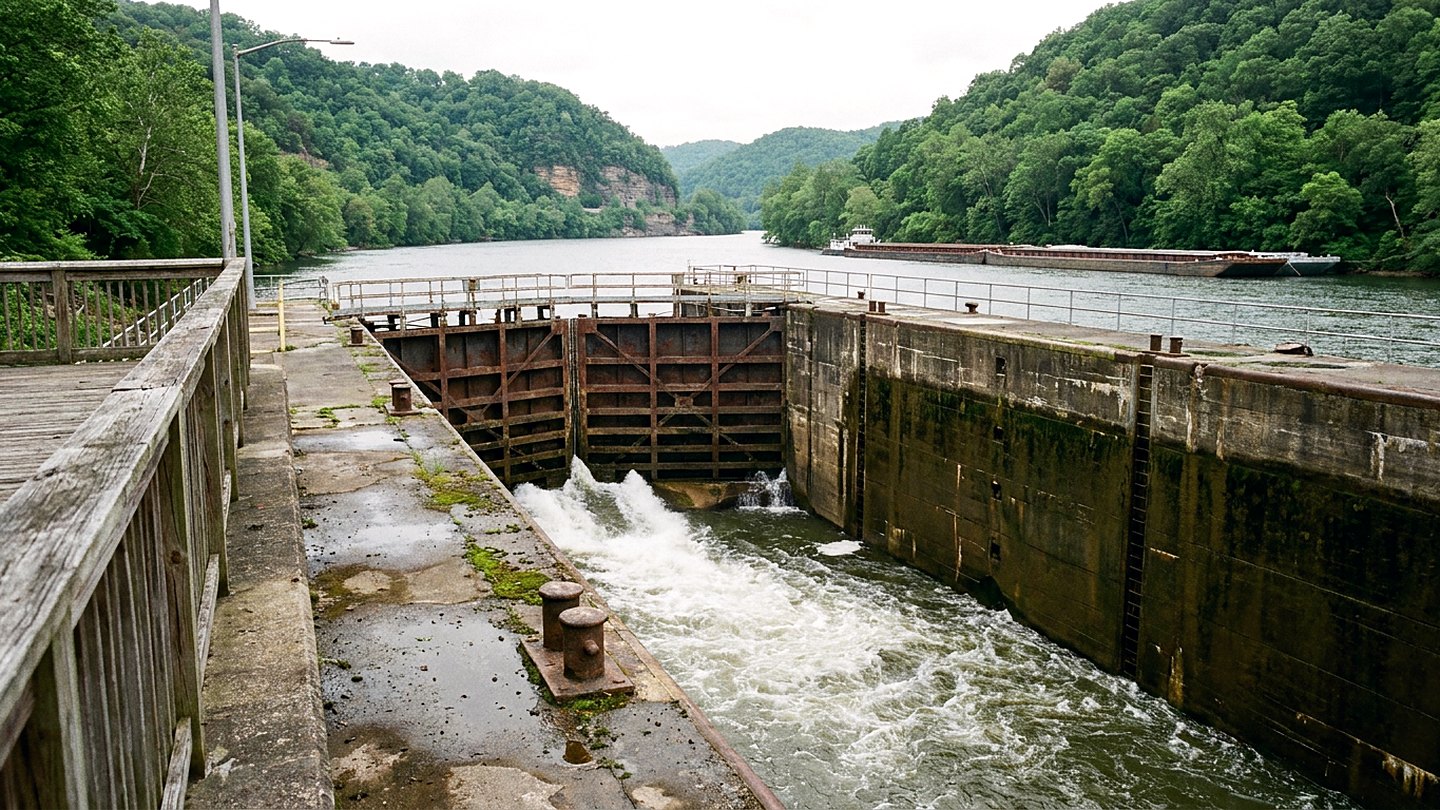
Forty-seven minutes, gate to gate
I started the watch when the head of the tow came clear of the bend. These are the marks I wrote down.
- At zero the tow was in sight upriver, coming down slow with the barges made up ahead of the boat.
- At six minutes the pilot had it lined up on the long chamber, and the light on the wall changed.
- At eleven minutes the upper gates were open and standing back in their recesses.
- At fourteen minutes the lead barge entered, and the closing speed was about that of a person walking.
- At twenty-one minutes the tow was fully inside and the crew had lines on the wall fittings.
- At twenty-four minutes the upper gates closed behind it.
- At twenty-six minutes the water started down, and the barges started down with it.
- At thirty-nine minutes the level had matched the lower pool and the movement stopped.
- At forty-one minutes the lower gates swung open.
- At forty-four minutes the boat began to push out.
- At forty-seven minutes the last barge cleared and the chamber sat empty again.
The drop looked to me like two stories, give or take, and it took thirteen minutes to happen. That is the number that surprised me most. I had assumed the water part was the slow part. It is not. The slow part is lining up, entering, and tying off, which took twenty-one minutes of the forty-seven.
The boat had a name across the pilothouse. I am not going to print it here, and I have nothing to say about who owns what on this river. The work is the interesting part.
What it sounds like
Less than you would think, and stranger than you would think.
The engines are a low steady thump that you feel in the platform decking before you hear it properly. When the pilot backs down to slow the tow, the note drops and the water behind the boat turns brown and boils up in a wide patch. That is the loudest moment of the whole lockage, and it is not loud.
After that it is small sounds. Wire dragging on steel. A gate motor working somewhere with a whine that starts and stops. Water moving under the floor with a hiss you can only hear if the wind quits, which mine did for about a minute at the right time. A radio, too faint to make out words. Gulls the entire time, working the water below the dam, where the spill keeps things stirred up.
There is also the smell, which nobody warns you about: warm river, diesel exhaust, and wet concrete, in that order.
What took the time
Ninety-four minutes on site, and it broke down like this.
- Twenty-two minutes at the rail before anything came, which I would do again.
- Forty-seven minutes on the lockage itself, watch running.
- Fifteen minutes reading the panels near the stairs, which explain the gates better than I just did.
- Ten minutes walking the paved path along the bank, looking back at the dam from downstream.
What it came to
Fifty-two miles of driving, one hour and ten minutes at the wheel, ninety-four minutes standing at a rail, and one complete lockage timed end to end. I was back in Charleston before noon.
It will not suit everybody. There is a flight of metal stairs to the platform and no way around it, and the platform has no shade, no seating, and nothing between you and the sun. Traffic on the river is not scheduled for your convenience, so you may stand there an hour and see nothing at all, or you may pull in at the perfect moment the way I did. Small children may run out of patience around the thirty-minute mark, when the water is going down and nothing appears to be happening. And if you need to know exactly what you will get before you leave the house, this is the wrong hour to pick.
What I took home is that the river still does heavy work in plain view, on a schedule nobody publishes, forty-seven minutes at a time.
The count
- Time on site 94 minutes
- Driving 52 miles, 1 hour 10 minutes at the wheel
- One lockage, end to end 47 minutes
Checked against
- Public pages of the river authority that runs the locks, read in general terms for how a chamber is filled and emptied
- National Weather Service forecast for the middle Kanawha Valley, for wind and the chance of an afternoon shower
- My own watch, started when the head of the tow came into view and stopped when the last barge cleared

Wes CardwellFounder and editor. Charleston, West Virginia. Every trip on this site was driven, walked, and timed by hand.