The Coonskin Overlook Before Work
I keep a short list of places I can reach and leave before eight in the morning. The overlook above Coonskin has been on that list for years. In February it is the one I choose when I want to see the whole city at once.
The plan is simple enough. Leave the house at twenty till seven, be at the top by seven, and be at my desk by ten after eight. It works because the park road is short and because nobody else is up there on a Tuesday in winter.
Sunrise was posted at seven twenty-nine, and that is not when the light arrives up there. The ridges to the east go bright first, and the flat ground below stays in shadow for another twenty minutes after that.
The road up
From downtown it is five and seven tenths miles to the overlook, and I did it in seventeen minutes going. Most of that distance is flat: out across the bridge, up the river road on the north side, then the turn in at the park gate.
The park road is where the trip actually starts. It climbs in a series of switchbacks, none of them severe, but the pavement narrows and the shoulders are soft. In February there is grit and salt sand piled in the outside of every turn from the last storm.
I took it in second gear at about fifteen miles an hour and met nothing coming down. The road was dry in the sun and damp in the shade, which is normal on that slope until the middle of the day. Two of the turns had leaf pack sitting in the gutter line. One had a small slide of rock at the base of the cut, maybe a foot of loose material.
At the top there is a paved loop and a gravel pull-off with room for six vehicles or so. I left mine at the pull-off and walked twelve stone steps up to the shelter. The steps were dry and the handrail was cold enough to feel through a glove.
The bowl at seven
The city sits in a bowl here, and from up top you finally understand the shape of it. The Elk comes down from the north and the Kanawha comes in from the east. The flat ground where they meet is the only flat ground for miles.
At ten after seven the bowl was full of cold air and the buildings downtown were still gray. The ridges on the far side already had light on them, a thin band along the tops, moving down maybe a foot a minute. The tallest buildings caught it well before the streets did.
I could hear the interstate. It is more than two miles off and it never stopped the whole time. The sound is steady and low, like water moving through a pipe. Under that there was nothing else at all until about seven twenty-five, when a train horn came up from the river.
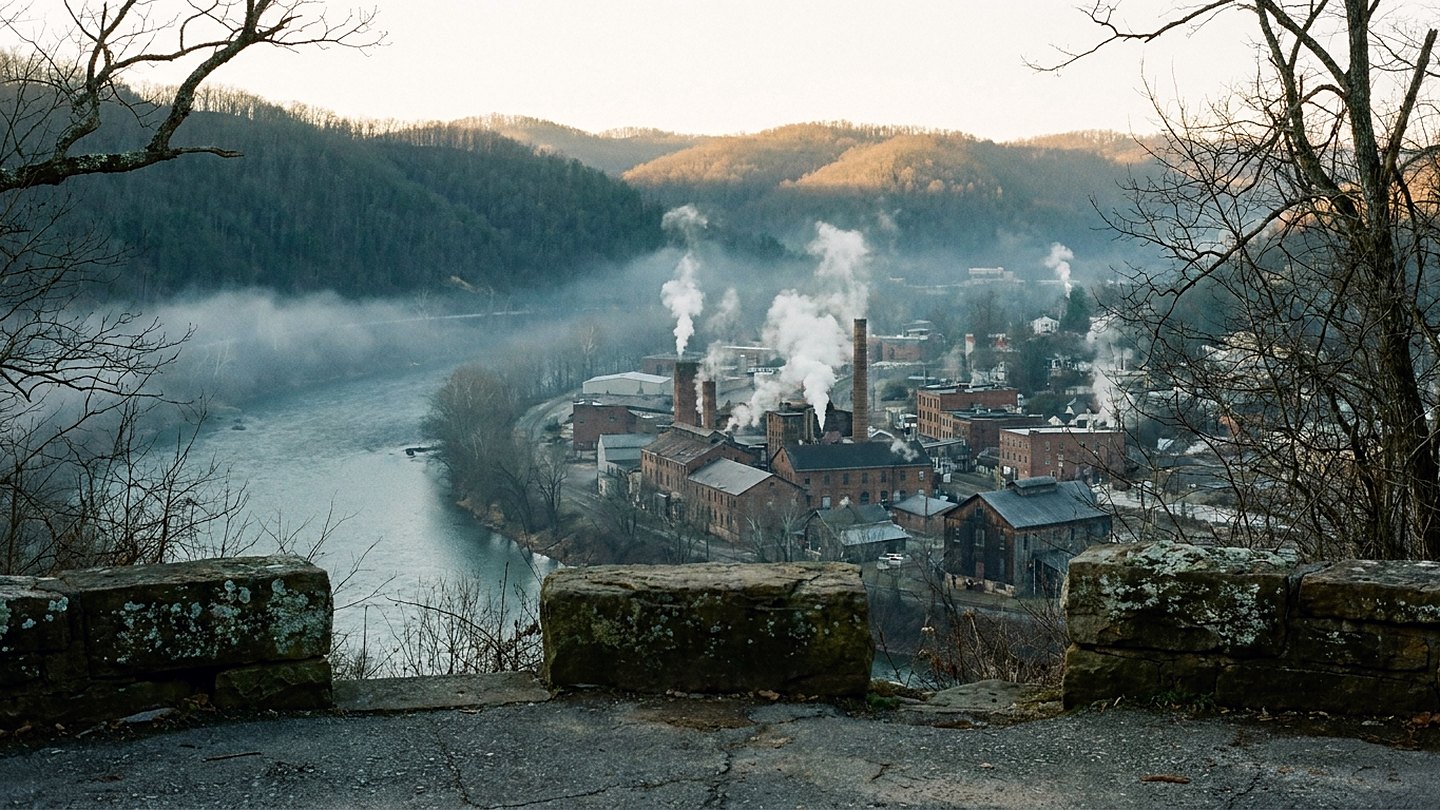
Smoke, and what it tells you
The thing that makes a cold February morning up there different from any other is the smoke. On a still morning every stack and chimney in the valley puts up a column. Every one of those columns stops at the same height and flattens out sideways.
That flat ceiling is an inversion. Cold heavy air sits down in the bowl, warmer air rides on top of it, and nothing crosses the line between them. You can see the exact elevation where it happens, because a dozen separate plumes all turn at once.
I counted eleven columns I could pick out clearly. The tallest of them were on the west end and the shortest were house chimneys on the near hillside. All of them bent over at what I would guess was six hundred feet above the river.
Sound behaves oddly under an inversion too. The train horn at seven twenty-five arrived far louder than the distance should have allowed. It also hung on in the air longer than it had any business doing.
What took the time
Fifty-five minutes at the top, and I spent very little of that walking. The loop up there is short and I made one slow lap of it, maybe four hundred yards in all.
The time went to three things:
- Watching the light come down the far ridges, which took about twenty-five minutes from first band to full slope.
- Picking out and counting the smoke columns, which I did twice because I lost my place partway through.
- Standing in one spot doing nothing whatever, which accounted for most of the rest.
The cold was manageable at thirty-one degrees with almost no wind. Up there the wind is the entire question. On a breezy morning that stone shelter turns into a plain wind tunnel. I have walked back down to the car after fifteen minutes more than once.
What I did not expect
The deer. Four of them crossed the loop road at seven forty, unhurried, and went down the slope on the east side into the bare timber. I have been up there thirty times and I still stopped moving when they came through.
I also did not expect the road crew. A county truck came up at seven forty-five to look at the slide I had driven past. That answered the question of who watches that road in winter. They set out two cones and went back down.
That is the sort of thing you only see if you go on a weekday before eight. On a Saturday afternoon in October the same overlook is a different place with a dozen cars in the loop.
What it came to
Fifty-five minutes at the overlook. Eleven and four tenths miles of driving, with thirty-four minutes of that moving. I was at my desk at ten after eight with better than nine hours of daylight in front of me.
The footing is easy if you can manage twelve stone steps with a rail. The gravel pull-off is uneven along its edges and soft after rain. There is no railing on the outside of the loop road where the ground falls away.
This one does not suit anyone who dislikes narrow mountain roads in winter. The switchbacks are not steep, but they are tight, and grit in the turns is normal up there until spring. There is no shade problem in February, and there is no shelter from wind either.
If the forecast says clear, cold, and calm, go. The flattened smoke only shows itself on those mornings, and it is the whole reason to make the climb before work.
The count
- Time on site 55 minutes at the shelter and on the loop
- Driving 11.4 miles, 34 minutes moving
- Daylight left 9 hours, 35 minutes
Checked against
- Kanawha County parks pages, for the park road, winter gate hours, and overlook access
- West Virginia state park pages, compared for how other overlook roads are posted in winter
- National Weather Service forecast and sunrise listing for the Kanawha Valley

Wes CardwellFounder and editor. Charleston, West Virginia. Every trip on this site was driven, walked, and timed by hand.